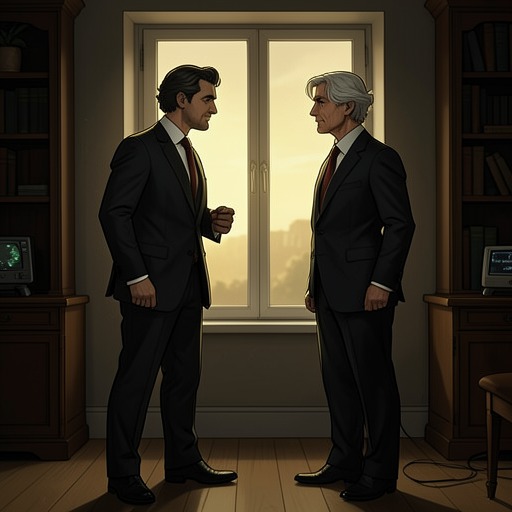
Witch Weekly offices
The Rules of WerewolfWitch Weekly offices are the opening setting and decisive social stage of the story. They host the Witch Weekly 2010 Ten Most Influential Witches & Wizards photo shoot, bringing together former schoolmates, Ministry figures, a published author, a heroic Auror, and Hermione Granger, whose arrival transforms the evening from a tedious professional obligation into the first visible spark of her renewed connection with Draco Malfoy. The offices therefore function both as a workplace and as a threshold: a public room organized for observation becomes the place where two wary former enemies begin watching one another.
Definition and Setting
The offices are introduced as the location in which the story opens and as the headquarters of the photo shoot. The atmosphere is hurried and tightly managed. Parvati Patil-Weasley moves around the room with purpose, pride, and mounting impatience, gathering the participants into a small semicircle and issuing instructions so the production can be completed quickly. She divides the attendees into sections, plans a larger group photograph, and promises to have everyone out within forty-five minutes, making the space feel less like a relaxed social gathering than a temporary production floor governed by schedules, cameras, and commands.
The room also contains a small crafts-service station with bottles, including Prosecco and champagne, and a modeling area arranged for individual and group photographs. Patil’s use of a Muggle device to coordinate the shoot adds another layer to the offices’ modern, hybrid character. The setting belongs to the wizarding world, but its professional culture is visibly receptive to Muggle technology, fashion, photography, and commercial presentation.
The Photo Shoot as Public Stage
The central activity in the offices is the production of the issue’s Ten Most Influential feature. Patil first sends the five-person Gringotts team to be photographed, while the remaining participants wait by the windows. Their inclusion reflects the varied forms of influence being recognized: the Gringotts group is associated with a Muggle-facing interface and easier banking exchange rates, while Draco Malfoy is present partly because his charitable donations qualify him for the list.
That criterion immediately exposes the symbolic economy of the room. Pansy Parkinson explains that Draco is considered influential because he donates substantial sums, but Draco objects to being evaluated by expenditure rather than by his work. He emphasizes that he is now an Auror and would prefer recognition for professional achievement. The offices thus place different kinds of status beside one another: money, publication, public service, institutional innovation, and media visibility are all converted into a single influential-personality image.
The photography itself reinforces that conversion. Patil arranges Pansy alone with her book, then positions Draco in a deliberately confident pose, one hand inside his robes and the other in his pocket, his jaw raised as he performs the image of controlled authority. He is not shy before the camera and understands how to produce the perfect picture, even while complaining that he does not understand why he has been invited. The offices require him to occupy both roles at once: reluctant participant and polished public figure.
Hermione Granger’s Arrival
Hermione Granger enters in a rush, apologizing to Patil for being late after an emergency. Her arrival changes the emotional geometry of the room. She is dressed in a petite black suit and heels, with her hair arranged in loose curls, and Draco’s attention shifts immediately from boredom to stunned physical awareness. His former enemy and school rival is no longer encountered as a passing figure in the Ministry’s Atrium but as a striking adult woman presented within the highly visual environment of a magazine shoot.
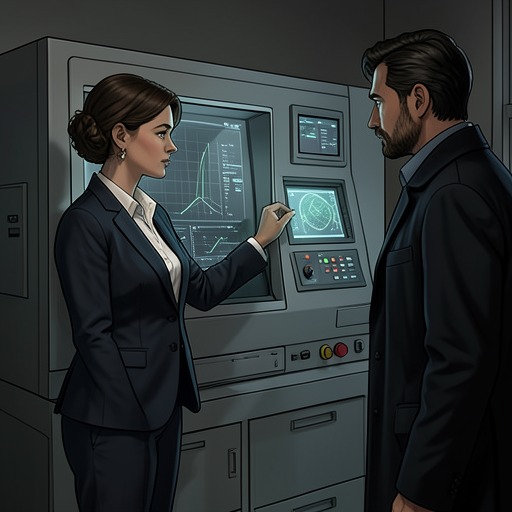
Hermione’s reason for appearing is more substantial than fashion or celebrity. She explains that she has spent the last few years reworking the Trace because its operation after Harry Potter’s experience had never sat right with her. Her revised system can distinguish between magic performed by an underage witch or wizard and magic merely performed in that person’s presence, and the Wizengamot has recently approved it. The offices therefore give her a platform on which institutional reform becomes public influence. Her achievement is both a technical intervention and a deliberate separation from the reputation she acquired through association with Harry Potter.
When Hermione asks Draco whether the achievement means she is no longer riding Harry Potter’s coattails, she turns the magazine’s language of influence into a personal challenge. Her confidence, victory, and teasing gesture unsettle him precisely because they combine intellectual accomplishment with direct address. In the offices, Hermione is not merely being photographed as an influential witch; she is actively defining the terms by which that influence should be understood.
Mutual Gaze and the Threshold of Pursuit
The most consequential action in the offices occurs during the group photographs. While Draco poses, his eyes wander from the lens and meet Hermione’s honey-colored gaze. She appears absorbed in thought, with her head slightly cocked and brows furrowed, and does not initially realize that he has noticed her attention. Patil’s command for Draco to look forward breaks the moment. Hermione then hides her own attentive gaze behind the screen of her Muggle mobile device.
This exchange is brief, public, and deniable, but the narrative treats it as the room’s true event. The camera is supposed to organize everyone’s attention, yet Draco and Hermione redirect that attention toward each other. The official photograph turns a private-looking act of mutual observation into part of a public image. Patil later captures a candid photograph of them locked in a replaying eye gaze while Hermione is speaking to Draco, and that image becomes the cover photo that repeatedly unnerves Hermione.
The offices consequently produce two kinds of looking. There is the controlled gaze of the photographer, which arranges bodies into influential public identities, and there is the involuntary gaze exchanged by Draco and Hermione, which exceeds the assigned poses. The first is designed for publication; the second becomes the beginning of pursuit. After the shoot, Draco keeps returning to the cover and replaying their intense eye contact, while Hermione is troubled by the way the published image fixes an experience she has not yet learned how to name.
Immediate Aftermath and Narrative Significance
The shoot ends as quickly as Patil promised, with the issue due to appear within seventy-two hours. Hermione takes an unopened bottle of champagne from the service table and leaves before Draco can reengage her, forcing him to rethink how to approach her. The office’s efficient closure contrasts with the persistence of what it has set in motion: the professional event ends, but the gaze continues in memory, in print, and in Draco’s growing preoccupation.
Draco later studies the Witch Weekly issue repeatedly, especially the cover image of himself and Hermione. He has arranged for a note to reach her office, using a Ministry favor and bribery to obtain information about her employment history, and he waits anxiously for a response. The offices are therefore linked directly to the first stage of his active pursuit. What begins as an unwanted appointment becomes the emotional highlight of his week, and then of his year, because their verbal sparring and mutual attention awaken a fascination he cannot dismiss.
For Hermione, the offices remain equally ambivalent. The article publicizes her Trace rework and gives her achievement institutional recognition, but the cover transforms her moment of attention toward Draco into an image visible to others. The setting thus joins professional validation to emotional exposure. Its publicness is what makes the encounter consequential: the photograph preserves the attraction before either character openly accepts it, turning the workplace into the first threshold between old rivalry and new desire.